

Getting cited in AI search takes two things working together. You need a clear, well-structured website, and a strong presence across the third-party sources AI reads. Most brands are doing the first and neglecting the second.
Your own pages matter. They define who you are, what you do and which category you belong in, and they help AI understand your positioning. But they can only carry what you say about yourself. When someone asks ChatGPT, Perplexity or Google’s AI for a recommendation, the systems lean heavily on what credible, independent sources say about you, in coverage you don’t publish and can’t control directly.
That second half is earned media, and earning it is what public relations does. If you’re optimising your website but doing little on the PR side, you’re missing the element AI relies on most. The brands that show up in AI answers tend to be strong on both. They have a site that’s easy to understand, and a consistent, credible footprint across the publications that shape their market.
Why your brand isn’t showing up in AI answers
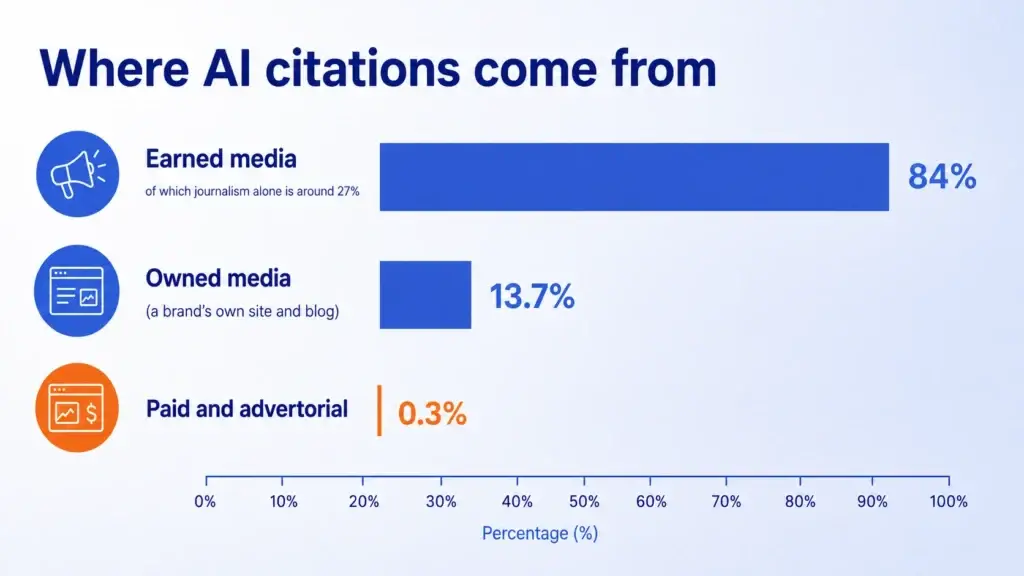
Most often because you’ve covered the owned-content half but not the earned-media half. A clear, well-structured website gets you into the running. It’s third-party coverage that AI cites most. The largest study of its kind found that earned media (coverage in news, trade and industry titles, rather than paid placements) accounts for around 84% of all AI citations, while paid and advertorial content makes up just 0.3% (Muck Rack, What Is AI Reading?, May 2026).
That figure isn’t a blip. Across three editions of the same study going back to July 2025, the earned-media share has stayed in a stable band of 82% to 89%, with journalism alone making up a quarter to just over a quarter of everything cited. When a pattern holds that steady across model updates, it’s telling you something structural about how these systems choose what to trust.
So when your optimised pages don’t get you into AI answers, it isn’t usually a fault in your website. It’s that the website is only half the job. AI is also looking somewhere your pages can’t reach. It is reading the open, third-party web where reputation is earned rather than claimed.
Earned vs owned, and what AI actually cites
Owned content defines your position. Earned coverage is what AI retrieves and trusts. Both matter, but they do different jobs. Your website tells AI what you say about yourself. Independent coverage tells AI what credible others say about you, and that second signal is the one that carries weight when AI decides whom to mention.
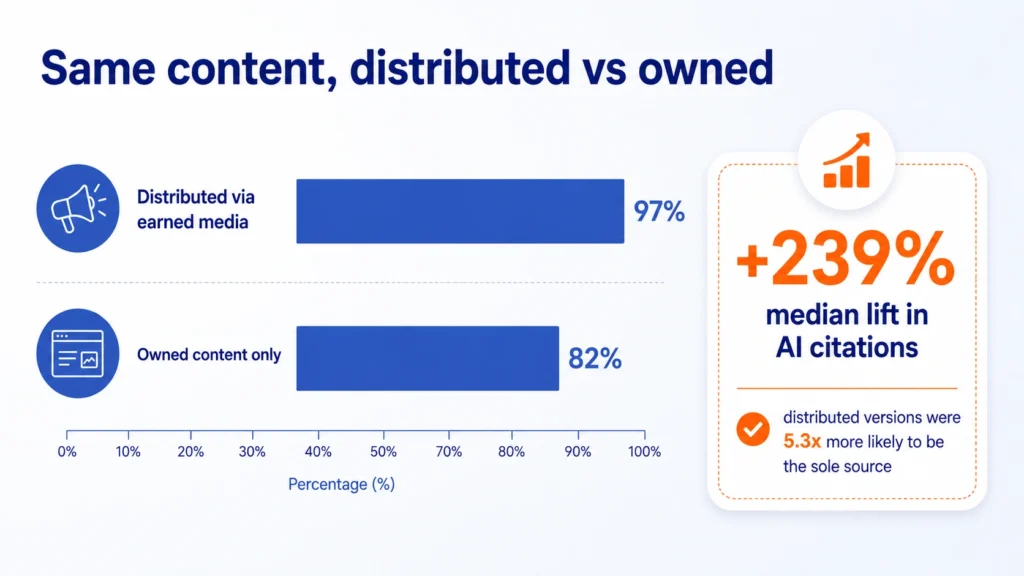
The strongest evidence that this is cause and not coincidence comes from a study by Stacker and Scrunch. Taking the same content and distributing it through earned, third-party channels produced a median 239% increase in AI citations compared with the brand’s own pages alone. In that study, 97% of the distributed stories earned at least one AI citation, against 82% for owned content, and the distributed versions were over five times more likely to be the sole source behind a brand’s AI visibility than the company’s own website (Stacker/Scrunch, March 2026).
A separate analysis of 75,000 brands by the SEO data company Ahrefs found the same pattern from a different direction. Brand mentions across the web correlated with visibility in Google’s AI Overviews about three times as strongly as backlinks did, and Ahrefs’ wider analysis found the same effect across ChatGPT and Google’s AI Mode. Three independent measurements, using completely different methods, all point the same way. AI prefers what others publish about you over what you publish about yourself.
From domain authority to entity authority
The goal has shifted from ranking a page to being recognised as an entity. For years, digital PR was measured by links and the domain authority they built, all in service of ranking higher on Google. AI doesn’t rank pages the same way. It identifies relationships between companies, people, topics and areas of expertise, then draws on the brands it understands most clearly.
An entity is simply a recognisable “thing” on the web. It might be a company, a person, a product or a topic. If your brand is repeatedly mentioned in credible contexts alongside a particular issue or specialism, AI systems are more likely to connect you with it. A firm quoted often on, say, insurance compliance across several respected trade titles gives the model more evidence to associate that firm with the subject, and so to surface it when someone asks.
This is why brand mentions out-predict backlinks.
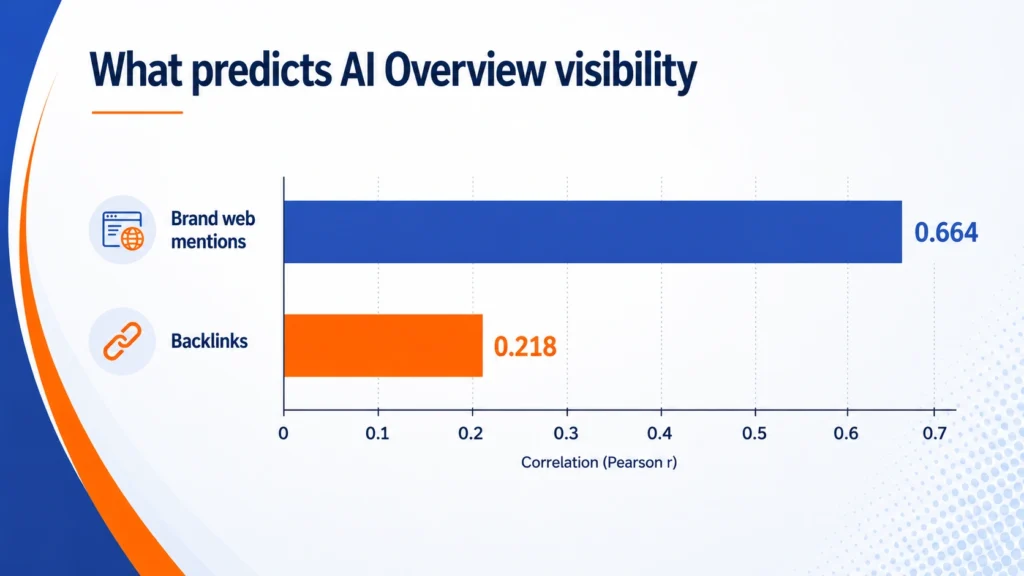
A backlink tells AI where to go. A mention tells AI what you’re known for. Earning those mentions in the right places is, again, the work of PR.
Why specialist firms have the advantage here
Relevance and credibility matter more than sheer volume, and that plays to a specialist firm’s strengths. AI systems don’t reward a long list of any-old mentions. They draw on credible, topic-relevant sources, and niche authority counts for more than generic outlet count (Muck Rack, May 2026). Coverage in the trade titles that genuinely shape your sector does real work here.
That doesn’t mean trade coverage is all that counts. National press and broadcast media carry serious authority with AI too, and a feature or expert quote in a respected national outlet can be every bit as valuable as a specialist one. The strongest footprint usually combines the two. Deep, relevant trade coverage proves you own your niche, and national or broadcast coverage confirms you matter beyond it.
This is where specialist firms, and the boutique agencies that understand their world, are well placed. The aim is not to be everywhere. It is to be the credible, recognised name on your subject across the outlets that count, trade and national alike. Volume is not the advantage. A clear point of view and genuine expertise that earn relevant, authoritative coverage are.
Your experts are an AI visibility asset
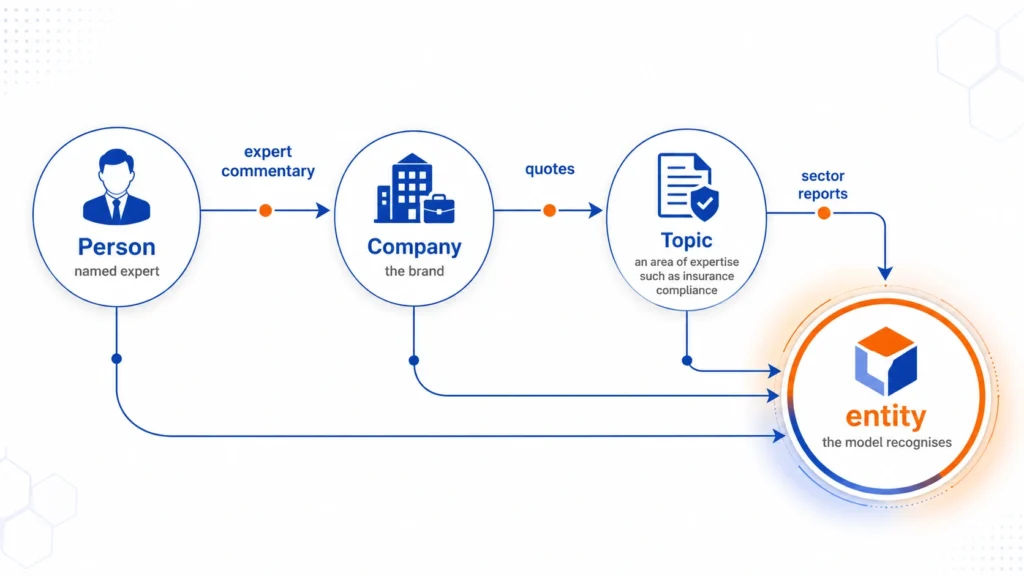
Named experts create connections AI can use. When senior people publish commentary, contribute bylined articles, give quotes to journalists or appear in sector reports, they build associations between their name, their company and a specific area of expertise. AI understands people, roles and topics, not just company names, so a business with visible, quoted experts is easier for a model to place than one that only publishes marketing copy.
Our founder James Simpson puts it this way.
“PR has always been a powerful way for brands to build visibility and earn independent credibility. The rise of LLMs and AI search adds another important layer to its value by helping brands appear in the sources, conversations and contexts that AI tools use to shape their answers and brand recommendations.”
This is where thought leadership earns a second return. The same expert commentary that builds your profile with human readers now also feeds the systems those readers increasingly ask first. A consistent, well-managed executive presence, including on LinkedIn, is no longer just good for reputation. It’s part of how AI learns who you are. When we built SEMPRIS’s social presence, the brief was to make them visible to the right audience. The same principle now applies to making a brand visible to the models that audience consults.
Consistency is the multiplier
Describe yourself the same way everywhere, or AI struggles to place you. LLMs work on patterns. If one source calls you a consultancy, another a platform and another an outsourcing firm, the signal blurs and the model can’t categorise you cleanly. When your category, value proposition, sector focus and terminology stay consistent across your website, press releases, bylines, award entries and third-party profiles, the picture sharpens and you become easier to cite.
This doesn’t mean every piece of coverage should read identically. Journalists need genuine stories, not a repeated script. It means the core language about who you are should hold steady wherever it appears. Aligning that language across owned and earned channels is squarely PR and content work, and it’s one of the highest-leverage things a specialist firm can get right.
What to do now
Start by finding out how AI currently describes you, then build authority in the places that move the needle. The sequence matters more than the volume of activity.
- Audit your current AI visibility. Run your most important sector, service and problem-led queries through ChatGPT, Perplexity and Google’s AI answers. Check more than one platform. They source differently, so where your buyers ask changes who gets cited. Record whether you appear, who does instead, which sources are cited and what language is used to describe the market.
- Identify the publications that actually shape your sector. Not the ones with the highest domain authority, but the niche, topic-relevant titles AI draws on for your category. A handful of the right outlets beats a long list of the wrong ones.
- Build consistent expert commentary. Give your spokespeople clear, defensible points of view and get them quoted, bylined and referenced on the issues your buyers are researching. AI leans even more heavily on journalism for trend and “what’s changed” questions, so timely, newsworthy commentary matters as much as evergreen expertise. Use research, data and real examples that journalists and editors want to use.
- Tighten your messaging across every channel. Make how you describe yourself on your website match how you’re described in press releases, interviews, bylines, award entries, LinkedIn and third-party profiles.
This is the heart of what we do. Our public relations work is, in effect, AI-visibility work. Earning credible, sector-relevant coverage is exactly what puts a brand into the sources AI trusts. If you’d like to understand how your brand currently appears in AI answers and shape a plan around it, get in touch.
Frequently asked questions
Does PR really affect AI search results?
Yes. Independent studies in 2025 and 2026 consistently find that the large majority of AI citations come from earned, third-party sources rather than brand-owned websites, around 84% in Muck Rack’s May 2026 analysis. PR is how that third-party coverage is earned, which makes it a direct lever on AI visibility.
Is optimising my own website still worth doing?
Yes, it’s necessary but not sufficient. A clear, well-structured site helps AI understand your positioning, and a large share of AI answers still draw on pages that also rank well in traditional search. Owned content gets you into consideration. Earned coverage is often what tips AI toward citing you over a competitor.
How do I know if AI is already citing my brand?
Run your key queries through ChatGPT, Perplexity and Google’s AI answers and note whether you appear, who’s cited instead and how the market is described. Repeating this monthly shows whether your visibility is improving over time.
Do I need a huge PR budget to get cited by AI?
No. The evidence suggests relevance and consistency beat sheer volume. AI tends to favour niche, topic-relevant coverage over a long list of generic mentions. A focused presence in the publications that shape your sector is well within reach of a specialist firm.