

AI has probably changed marketing forever and transformed the way we access information. Marketers are producing content at scale, information is everywhere, and answers are available in seconds. Of course there is a downside.
With so much content competing for our attention, knowing what to trust is becoming harder than ever.
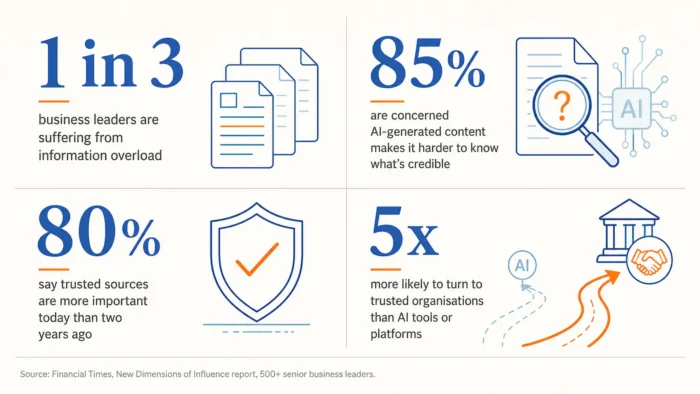
That was one of the biggest takeaways from the Financial Times’ recent report, New Dimensions of Influence. Based on research undertaken with more than 500 senior business leaders, the report explores where leaders go for trusted information when making important business decisions.
TMCC’s Account Director, Fiona Simpson recently attended the launch of the report, and she concluded that the research findings should make every leader stop and think.
Key findings from the FT report
As Finola McDonnell, Chief Communications and Marketing Officer at the Financial Times, explained:
“One of the challenges of this hyper-information system that we live in… is that we try to consume all of it and then try to make sense of all of it. And it’s too difficult.”
That really resonated with us. Businesses aren’t short of information, they’re short of confidence in what they’re reading.
Trust is becoming your greatest marketing asset
The report found that before business leaders trust information enough to act on it, they look for four things:
- Evidence that stands up to scrutiny.
- Different perspectives that add context.
- Ideas that challenge assumptions.
- Brands with credibility.
In other words, your marketing has to do more than attract attention or generate leads, it must build trust.
Businesses that consistently educate, share genuine expertise and demonstrate measurable impact are far more likely to become trusted advisers rather than simply suppliers.
One of the report contributors captured this perfectly:
“I don’t want more of the same. I want fresh perspectives.”
And Nick Fallon, The Financial Times’ Chief Strategy and Development officer said:
“Increasingly, I’m thinking of quality brands as being a kitemark for truth and trust in a world in which content is proliferating and the provenance and credibility of it is less clear over time.”
So what does that mean for marketers?
After attending the report launch in London, it got us thinking about what organisations should be doing differently to stand out in the age of AI and strengthen your brand’s credibility.
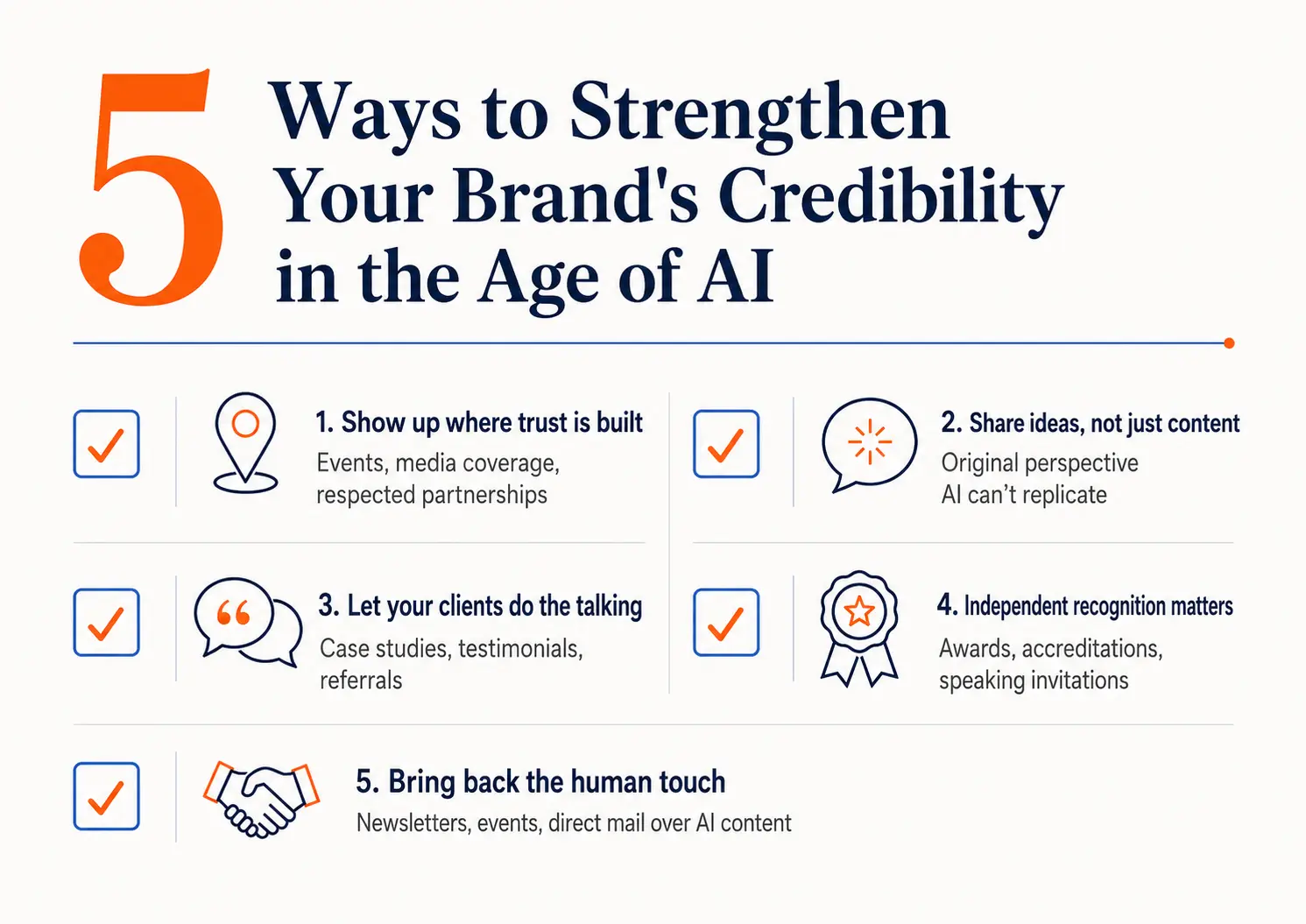
- Show up where trust is built
Where people see your brand matters.
Speaking at industry events, earning media coverage through PR, partnering with respected organisations and supporting your business community all strengthen credibility. People notice who you work with and who trusts you.
- Share ideas, not just content
AI can produce content in seconds. What it can’t replicate is your experience, judgement and perspective.
The best thought leadership helps people see something differently. It shares evidence, offers a fresh viewpoint and sometimes challenges conventional thinking.
In conversation with one of our clients recently, we mentioned the report as a good read and asked them what content or information they were looking for when making pivotal business decisions. They said:
“I want to find the stuff that I don’t know and challenges my thinking, but it has to be from someone or a brand or business I trust.”
That’s exactly what good thought leadership should do.
- Let your clients do the talking
Case studies, testimonials and referrals are some of the most powerful marketing tools you have.
They show real results and give prospective clients confidence that you can deliver.
- Independent recognition matters
Awards, accreditations and speaking invitations all provide third-party validation. They reassure potential clients that your expertise is recognised by others, not just claimed by you.
- Bring back the human touch
Interestingly, as AI-generated content becomes more common, tangible, human experiences become more valuable and create stronger emotional connections.
A well-written newsletter, an insightful in-person event or even a thoughtfully designed piece of direct mail can leave a much stronger impression than another AI-generated article.
In B2B marketing especially, people still buy from people they trust.
Human-made will become the premium
One observation from the panel discussion resonated strongly.
Future audiences have grown up with digital technology and AI. They expect convenience and speed, but they also crave meaningful experiences and authentic brands that make life easier.
As AI becomes commonplace, the organisations that stand out won’t necessarily be those producing the most content. They’ll be the ones producing the most trusted content, sharing ideas that help people make better decisions.
Perhaps that’s why the report describes ‘trusted brands as a shortcut for busy leaders.’ They don’t have time to verify every article or opinion, so they return to the organisations that have earned their confidence.
The visibility and reputation of your CEO should also not be underestimated when it comes to brand trustworthiness. Their voice is not just influential, it’s pivotal in shaping the perception of your brand and forging a deep connection with your stakeholders; whether external or internal. Read our blog on Mastering the Art of Leadership Communications.
A final thought
Your Net Promoter Score (NPS) is often viewed as a measure of customer satisfaction.
Perhaps it’s time to think of it differently. It’s also a measure of trust.
Because when clients recommend your business, they’re not simply endorsing your products or services. They’re putting their own reputation behind your knowledge, expertise and judgement.
The FT is one of the most trusted new sources in publishing, and case in point, trusted by TMCC to help shape this blog!
You can download the full report from The Financial Times here.